Saturday, February 13, 2016

The Changing Face of Le Sentier

We live in the Second Arrondissement, the smallest of the 20 "quartiers" in Paris, a mere 100 hectares, accounting for just one percent of the city! Within the neighborhood, there are  clear distinctions, and different names. Our flat lies within the upper green-colored square on the map above, where rue Réaumur meets rue d'Aboukir. Known to Parisians as Le Sentier, it's also known as the city's Garment District. Many of its street names -- rue du Nil, rue Caire, rue d'Aboukir, rue Alexandre -- celebrate Napoleon's Egyptian adventures. And perhaps it was Egyptian cottons that were first brought here, paving the way for the businesses that followed.

Since those days, and for well over 100 years, it has been home to the bustling, busy trade of fabric manufacturers, fabric sellers, wholesale and retail dress shops.

In 1910, this emporium on the rue d'Aboukir, is holding a special sale ("soldes") of its silks, linens and other fabrics ("tissus").

And in the Passage Caire, the central hub of the district, these ladies are taking a break from their work sewing cuffs ("manchettes").


Today, though, the Passage Caire no longer hums with such activity. The Passage itself is huge, with many entrances from the various side streets, but strolling through this week, I found many store fronts shuttered.


There are still some dress shops, with racks of clothing ready to be shipped to retail outlets...


...there are a few mannequin shops, the figures of all sizes waiting for clothes for all ages...

 ...and the Beverly Cafe still seems to be in business in the central walkway. A sign on the window indicates that it is, as always, under the control of the "Loubavitch de France" -- a reminder that, in its early days, this was largely a Jewish neighborhood.


Out in the winding side streets, you can still see men carrying bolts of cloth from a fabric wholesaler, loading them onto rolling carts and wheeling them to the fashion houses.


Or trundling a rack of clothes to a retail shop.

But more and more, these "middle men" are finding the times and markets are changing. Many clothing manufacturers now  buy their fabrics directly from China or India, no longer having a need for a broker in the Sentier.

In our own building, the venerable firm of T.C.R.M., who rented the third floor from the 1930s until last July (!) went out of business, replaced by the Films du Kiosque. Another "tissu" enterprise, formerly on the 1st floor, has been replaced by dermatologists!


I love to wander through the narrow, winding streets in the neighborhood, stopping to admire and be amazed at the variety of fabrics -- silks, lace, moiré, cottons -- in all colors from pastel to full on primary neon colors!


An open door to a retail shop ("vente au détail") as opposed to a wholesale shop ("vente en gros") is always a temptation!

Increasingly, though, this is what you notice: store front spaces for rent, businesses closed down.  With the influx of dot-com companies and techie start-ups into the district, it's been interesting to watch the new retail store-fronts that are establishing themselves to serve the needs of this new Sentier population.


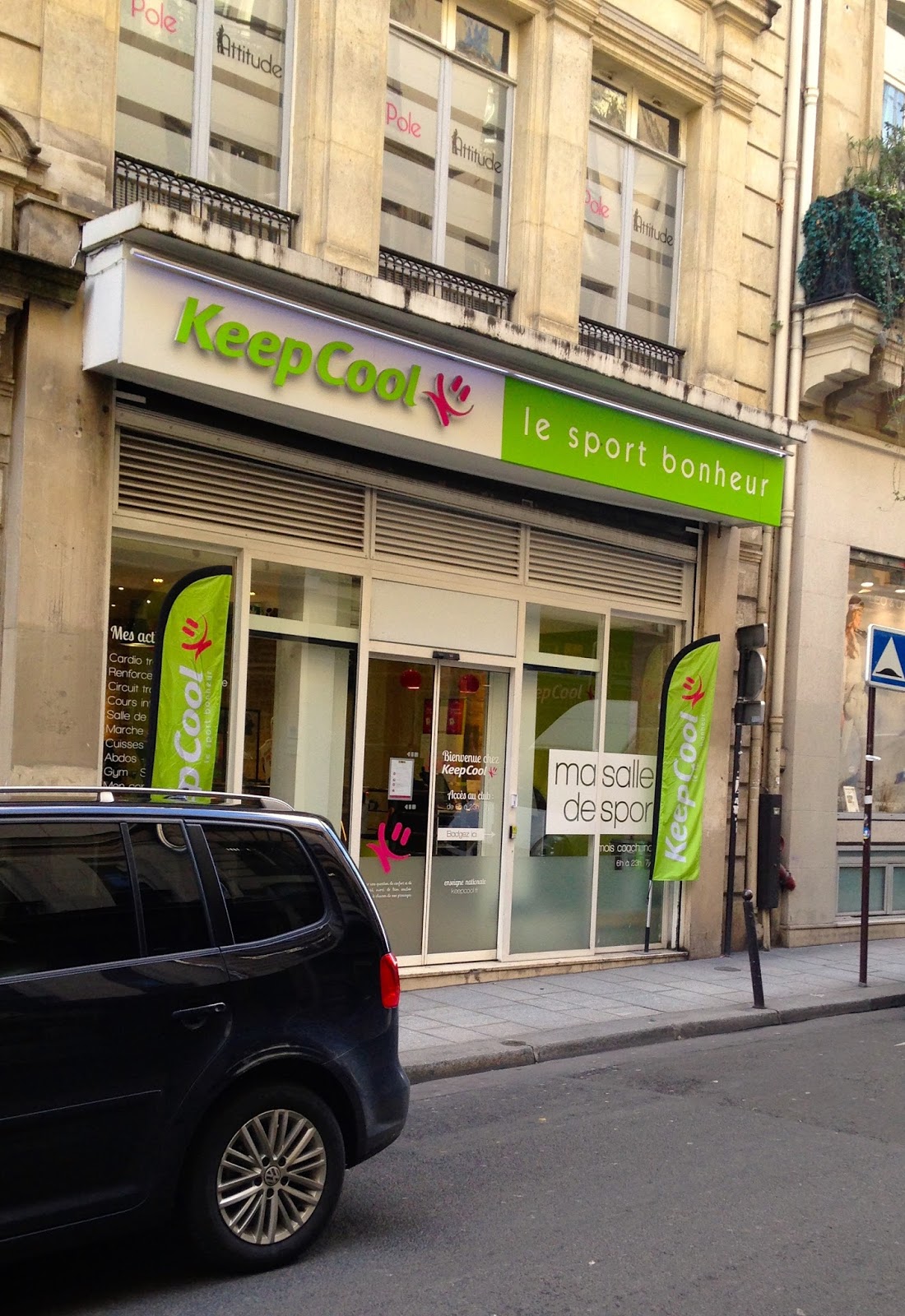
For example, my wonderful Keep Cool gym, on rue de Clery, used to be a fabric wholesaler. Then a fire destroyed the interior and all the contents. They never re-opened. Instead, it is now  home to scores of attractive young people, with a few of us of a more mature age, all doing our best to keep fit as well as keep cool!


Further up the street, a hoverboard boutique just opened, full of eager customers for this popular form of transport.

The window display features a pop-art comic-book wonder!


Round the corner, Mister Phony will repair, unlock or recycle your iPhone, and sell you all the accessories you ever dreamed of.

Lower down on rue de Clery, a "tissu" shop is now a "Co-working Cafe". Here you can rent a desk for an hour (4,5 euros), or a day (20 euros), with a wi-fi fiber optique hook up, coffee, tea, hot chocolate, snacks, books and playlists.


Across the street, Mon Atelier en Ville, offers you space by the hour or day to work on your DIY project, whether you are designing a dress or building a bench.


And on the other side of rue Réaumur, the same idea welcomes architects and designers to work on their projects.

The biggest change, though, has to do with good food and excellent restaurants! On the Place Alexandre, the Hotel Edgar, a former convent, has about ten rooms, each lavishly decorated by different designers and stylists. It is also home to one of the best restaurants in the neighborhood.


Other eateries seem to be popping up every week, with a variety of ethnic menus.


Some of them a somewhat strange mix -- Bagel Sushi?!


Nowhere is the "foodie" world more present than on the tiny rue du Nil, where Greg Marchand began it all with his Bistro Frenchie.


Formerly a street full of "tissus" wholesalers, there now remains but one, this brave vendor of beautiful African fabrics.


As well as Bistro Frenchie, M. Marchand opened a casual bar across the street, and a few doors down, a fast food version, Frenchie To Go...


...and, new to us this year, Frenchie Caviste, with a good selection of wines.


A bakery opened on the corner last October, where yet another "rag trade" business used to be.

Add to this the "farm to shop" greengrocer and cheese shop that has been here for about three years, and the organic butcher and fishmonger across the street, and you really have no need to go anywhere else to eat like kings, or shop for super fresh "everything" for your home cooking!

An anonymous writer once said "if nothing ever changed, there'd be no butterflies"! So whilst I welcome the Keep Cool gym and the food shopping on the rue de Nil and most of the other new arrivals, I hope there'll always be room (and business) for the little dress shops, the "tissus" boutiques, the mannequins in the Passage Caire, all the things that have made Le Sentier such a unique "quartier" and a great place to live.

It's supposed to snow in Paris this coming week, but we will miss it because India has beckoned -- we fly to Mumbai on Monday evening for a week, followed by a week of adventures in Rajasthan. Stay tuned for exotic blog posts when we return March 1st.

À bientôt!


Friday, February 5, 2016

If only walls could talk...

...then this elegant 18th century private home (hôtel particulier) in the centre of Paris would fill our ears for hours. Known today as the Hôtel de Talleyrand, it was originally designed and built between 1767 and 1769 for Louis Phélypeaux, Comte de Saint-Florentin, one of the most influential figures of the reign of Louis XV. From its earliest days, this neo-classical building was a focus of political power and diplomacy. When the American Women's Group of Paris offered a private tour to its members, I quickly signed up!


The architect Jean-Francois Chalgrin designed the interiors with a team of leading sculptors, painters and master ironsmiths. The grand staircase reflects their artistry in the sweep of the balustrade with ironwork by Pierre Deumier...


...the marble statue in its niche, reflected nicely in the mirror...


...and the glorious ceiling painting by Jean-Simon Berthélemy, titled La Force accompagnée par la Prudence portant à l'immortalité le globe de la France. What a testament to the Age of Enlightenment!


After the death of Saint-Florentin, the house passed through various hands, including being the Embassy for the Venetian Republic for a while, before it came into the possession, in 1812, of this gentleman, for whom the house is still named: Charles Maurice de Talleyrand-Périgord. From 1812 to Talleyrand's death in 1838, the house was considered ground zero for the highest levels of French society and for all the intrigues of political life. Talleyrand himself was already widely admired (and feared) for his diplomatic skills as he played them out through the regimes of Louis XVI, the French Revolution, Napoleon, Louis XVIII and Louis-Philippe! Some people believed he was brilliant (if crafty), others swore he was a cynical traitor.

Victor Hugo wrote this about Talleyrand and his house in his Choses Vues 1830 - 1848:  "Into this palace, as a spider into its web, he enticed and captured, one by one, heroes, thinkers, conquerors, princes, emperors, Bonaparte, Sieyès, Mme de Stael, Chateaubriand, Benjamin Constant, Alexandre de Russie, Guillaume de Prusse, Francois d’Autriche, Louis XVIII, Louis Philippe, and all the gilded glittering flies which buzz through the history of these past forty years. All this glittering swarm, fascinated by the penetrating eye of this man, passed in turn under this gloomy entrance bearing on it the inscription: Hôtel Talleyrand."

Certainly as we passed through the beautifully-restored rooms (now used as reception rooms for conferences and cultural events), the scope of his power became evident. In 1814 in this Salle d'Audience, Talleyrand brought together the leaders Czar Alexander I of Russia, King Frederick William III of Prussia, Emperor Francis I of Austria and the Duke of Wellington (the British Ambassador) to negotiate peace in Europe and the restoration of the monarchy in France and to prepare for the Congress of Vienna.

The Czar slept in this lavish bedchamber, in "le lit à la turque" (the Turkish bed). Sculpted and gilded beech wood forms the bedframe, adorned with sumptuous silk hangings, all a reflection of the interest in exotic orientalism in the late 18th century.  It appears to have been the custom to sleep in a reclining, half-seated position, which would account for the short length of the bed!


In this "Grand Cabinet", Talleyrand would receive those for whom he had a special regard, who warranted a particular, more private audience.


I imagine they would have greatly admired these panels of carved, gilded wood...


...as well as these exquisitely sculpted female figures, bearing trays of fruit.

For me, the most beautiful treasure was this clock, known as the "Astronomy Clock", with Urania herself seated beside a stack of books, a globe under her leg, a sextant lying by the books. And it still keeps perfect time!

A tiny room next to the grand bedchamber signals the arrival of the Rothschild family, who purchased the house after Talleyrand's death in 1838, and remained owners until 1950, more than 100 years! They took on some new construction, renovation and decoration under the supervision of Léon Ohnet. This room, with its ornamental wood-painted panels became either a dressing room or bathroom to young Guy de Rothschild in the early 20th century.


As well as its intricate marquetry parquet flooring...


...there is one panel in the back corner of the room that is not all that it seems.


A secret door led to a staircase up to the young man's bedchamber on the floor above. Today it is closed off with just a small plaque telling the tale!


Another beautiful clock adorns the fireplace in yet another spacious reception room that served as the Rothschild's dining room.


More meticulously sculpted figurines catch the eye, in this case depicting the four seasons. We decided this had to be "winter" as the poor young woman is half naked and shivering!


A window in the corner of the room looks onto the rue de Rivoli. From here, the Rothschild family would have been able to watch the Nazis marching into Paris in 1940. They subsequently occupied the Hôtel de Talleyrand during WWII. A sobering image on this grey February morning.

The final room we visited, La Grand Salle, brings the history of the Hôtel de Talleyrand through the years following WWII. In 1947, the US Government leased the house from the Rothschilds, purchasing it from them in 1950. And it is here that General George C. Marshall, as Secretary of State, sat down with Ambassador W. Averell Harriman to bring together 17 European countries, to create the American Administration of the European Recovery Program, better known as the Marshall Plan.

Under his leadership, General Marshall persuaded former enemies to set aside rancor, rivalries and revenge. With the help of the United States, they began the challenging task of rebuilding their economies, working to bind their communities together into a group of nations that some years later became known as the European Union.

Black and white photographs on display show the group of (mostly) men seated in this Grand Salle, surrounded by screens covered with photographs, data, proposals.

It was an astonishing undertaking at a time of enormous loss, upheaval and tragedy. The Plan, however, only looked to the future, intent on modernizing European industrial and business practices. In April, 1948, President Truman signed the Plan, granting $5 billion to begin the process of recovery. By 1952, when the funding ceased, $13 billion had been donated by the United States in economic and technical assistance. At this time, the economy of each European country exceeded its pre-War levels, and the Marshall Plan was deemed a "great success".

A plaque on the outside of the building commemorates the 50th anniversary of the Marshall Plan.

And a second plaque reminds us of the other great figure who lived here. Perhaps Talleyrand's long tenure in the house, his ever canny negotiating for peace and for the glory of France, no matter the political cost, has left a legacy that a diplomatic solution is always to be preferred over war, and has allowed so many good things to be achieved within its walls over the century and a half since his death. (Maybe the Syrian cease fire talks should relocate here.....)

À bientôt!


Friday, January 29, 2016

Settling In...

It's déjà vu all over again: we travel safely, our luggage travels safely, we reach the flat safely, turn on the water, the gas, the heat, unpack and stow the suitcases in the cave. And then for about ten days we sink into the deep impenetrable fog of Jet Lag! We try everything: sleeping pills, melatonin, face masks, ear plugs. To no avail. The old maxim that it takes one day for every hour of time difference seems to be true. All of which is to say, that nine days in, we are slowly emerging and beginning to pick up the threads of our life here, and to catch up on what's new.


In the flat itself, after a six month absence, there are shelves to be dusted and mugs and cups to be washed...


...the larder to be sorted and stale stuff dispatched into the "poubelle"...


...there is the annual, required, examination and maintenance of the chaudiere that provides heat to the radiators and hot water.


Once you take the front cover off, there's an amazing array of pipes, toggles, vents and dials.


Luckily, the technician is an old hand. He's come every time for the last three years...


...always glad to see us and to chew the fat with Matthew ("tailler une bavette")!


Within the building, fiber-optic cable has been installed since we were last here, which meant a visit from the Orange Fr. representative, who has duly hooked us up to this superfast internet highway.

Little green lights on the black boxes wink at us from beneath the sideboard.


My little temporary recording booth got set up perfectly and a new reading may be heard next Monday 10 am PST on www.kwmr.org -- "Good morning and welcome to Turning Pages at Nature's Pace....."

The biggest change in our immediate neighborhood is our building itself. Gone are the graffiti-scratched messages and symbols that previously adorned the ground floor walls. The space has stood empty for five years, after HSBC moved out, giving the building a grim, derelict facade at street level. Happily, a high-end Swedish sneaker boutique has moved in (Sneakers'nStuff), the granite walls are scrubbed, stained, polished...


...and the interior packed with very expensive sneakers! I don't quite understand it, but it appears some people buy a pair of sneakers and then just keep them, wrapped in tissue paper, in their box -- some kind of long-term investment?

Within the building, there are new tenants, including yet another film company -- we now have Recif Films, Ozon Films, Films du Kiosque, and, not forgetting, up here on the 5th floor, our very own January Films. A veritable Cincecitta in the making! This means new security, new locks, new magic grey plastic discs that magically let us in.

Happily, our close neighbors are still in residence. Their children brought us fresh baked cookies to say "welcome back"!


And my dear "Keep Cool" gym still offers plenty of ways to keep fit on the rue Clery.

Across the city, over in the 5th arrondissement, we're happy to see that the Pantheon restoration is completed, its beautiful dome once more visible on the horizon. Time for another visit!


Down the rue Montorgeuil, our local shopping street, all our favorites seem still to be in business. The city is quiet, though, even for this time of year. And there is a palpable presence of "authority", whether it's this police car that parked on the sidewalk, the driver behind the wheel, his two colleagues quietly patrolling the street, or the frequently seen posses of 5 or 6 soldiers in full combat gear. A startling sight.

But not enough to keep us from being out and about. Just two days ago, we went over to the Atelier Jault frame shop in the 14th arrondissement. Here, M. Jault examined our beautiful Marty Knapp photograph of Clear Lake that we brought with us. With his help and meticulous measurements, we selected a frame, non-reflective glass, a beautiful mat, and will return in early March to collect it!

And just last night, we were back at the Philharmonie de Paris where we heard Mozart's Piano Concerto #24, performed by Lars Vogt -- a big, burly, linebacker kind of a fellow, who played like an gentle angel -- and Bruckner's massive 5th Symphony. Deservedly, maestro Paavo Järvi and his Orchestre de Paris received a huge ovation.

So, I think the game's afoot! Next week I'm taking a tour of the Hôtel de Talleyrand, a late 18th century town house where Talleyrand received heads of state as first Prime Minister of France. Stay tuned!

À bientôt!