Spring has finally "sprung"! After weeks of grey skies and way too much rain and cool temperatures, the sun emerged this past weekend, bathing the city and all its inhabitants in much-welcomed warmth. Cotton trousers have been unpacked, tee-shirts can be worn without a turtle neck, and bare toes are at last seeing the light of day.
My first stop on Sunday was the oft-overlooked Musée Carnavalet tucked away in the Marais, in the 3rd arrondissement; the museum that tells the history of the City of Paris.
Not surprisingly, a handsome statue of Louis XIV by Antoine Coysevox greets you in the entrance courtyard. In 1689 it used to stand before the Hôtel de Ville in Paris.
The buildings (from the 16th and 17th centuries) are two former private homes, acquired by the city during the Second Empire at the instigation of that busy fellow, Baron Haussmann. The museum opened its doors in 1880. Today, there are 100 plus rooms that recount the history of the city from pre-historic times to the present day.
Before I got to the temporary exhibition space and the photography show I was wanting to see, I spent some time poring over some of the models on display, especially this model of the Île de la Cité in the 16th century. You can see Notre Dame, standing tall, surrounded by densely packed houses, most of which are now gone. Ste Chapelle is there, a couple of bridges and some kind of tall building on the left bank, which is definitely no longer there!
But the Théâtre de la Gaîté, which dates from the 18th century can still be found on the rue du Temple. Now known as La Gaîté Lyrique, it still presents musical concerts, but definitely of a more modern nature than the founders had in mind. The current playlist includes Punk in Africa, and The Hives!
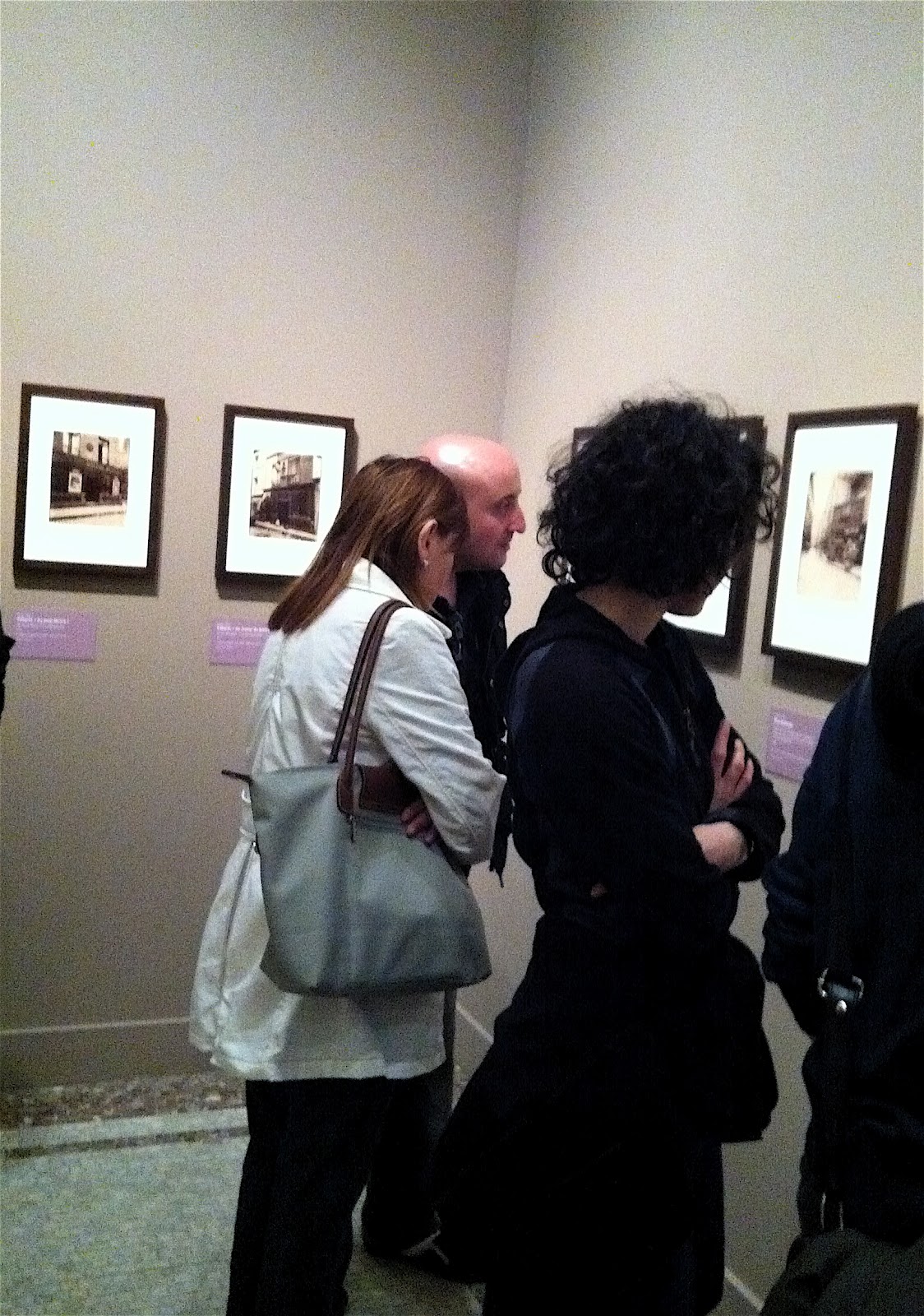
I was there Sunday to dive into late 19th/early 20th century Paris, as seen through the camera lens of photographer Eugène Atget. Some 230 of his photographs filled at least 8 or 9 rooms. He came to photography late, after some years as a merchant seaman and as an actor. He even tried painting. At age 40, he experimented with photography and found his life's work, documenting Paris life and culture.
Today, his images are icons, but during his lifetime, they didn't receive much attention. Towards the end of his life, Man Ray and Berenice Abbot took an interest in his work, recognizing the importance of cataloguing the life and times of a great city. They bought many of his photographs, published articles about his work and at his death undoubtedly influenced the Musée Carnavalet's acquisition of over 9000 of his images.

For me, the pleasure was to move slowly from one photograph to the next, standing as close as I could get so as not to miss any detail, and appreciating the simplicity of the poses but also the depth of information they contained. Looking at this peddler's lampshades ("un abat-jour", new French word for me!), I wondered how much he charged for them, who bought them, how many he might sell in a day, how heavy they were to cart around on his back, and who had actually made them. He seems well dressed, so perhaps he made a decent living. Not like the "rag-and-bone" men who used to come through English towns in the 1950s!
In another celebrated image snapped on April 17, 1912, Atget captured a small group gathered at the Place de la Bastille to look (directly, it would appear!) at a solar eclipse that was passing over the opposite side of Paris.
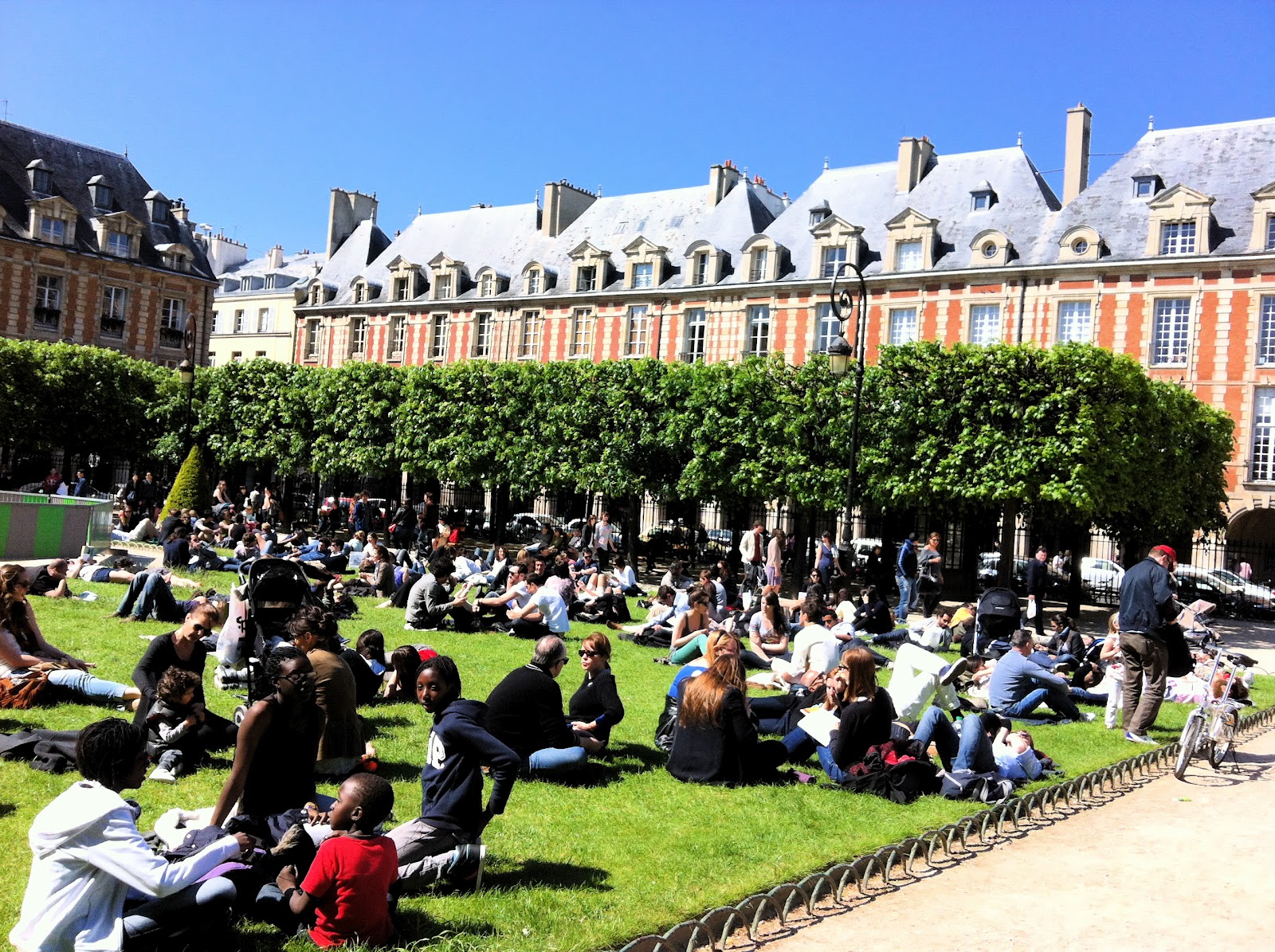
After wandering through all the Atget galleries, lost in those early 20th century days, I remembered that the sun was shining here on Sunday as well, and strolled over to the Place des Vosges gardens, where a blade of grass was hard to come by. By the now, the signs that decorate all park lawns during winter "l'herbe en repose" (the grass is resting!) have been removed and one can sprawl to one's heart's content.
Turning back into the Marais, I came across one of the largest temporary flea markets I've ever seen here, block after block, hundreds of stalls, selling the usual mixture of good quality, expensive stuff and complete rubbish...
..shoes in all sizes and in all conditions...
...unexpected objects of natural history...
...and some rather lonely-looking fur coats!
There was even a woman offering head massages, pleading, it seemed, for more customers.
Suddenly, the sound of drums caught everyone's attention. Marching down the street from the Place de la République came a huge parade, hundreds of participants, some walking, some riding in vehicles, led by a couple of official policemen, who were helped by parade monitors on roller blades. It was no small feat to navigate such a large crowd through a neighborhood that was already packed to the gills with flea market mavens.
Turns out it was Fair Pride Day 2012 on Sunday, reminding us of the importance of fair trade policies and good ethics in commerce, a noble if rather daunting cause!
That didn't stop the brightly-clad musicians from singing and banging, clapping and smiling as they marched along.
The warm sunshine certainly bolstered their spirits...
...although after 40 minutes or so of very raucous, boisterous yelling and stomping and drumming, I was sort of ready for a head massage myself!
Meanwhile, in another part of the city altogether, Matthew and friend Ed Koren took advantage of the beautiful day to bicycle across the Seine, over to Parc St. Cloud and on down through wooded trails and paths to Versailles and back, a mere 40 mile round trip!
There, just as in Paris, the whole world was out and about, boating on the bassins, lounging on the grass...
...while from the state rooms of the Chateau, the ghost of the Sun King himself must surely have also been looking on, smiling benevolently at his wondrous creation, although he must have wondered where all these people came from.
Two days later, at the Hôtel de Ville in Paris, he probably would not have been smiling, as crowds gathered to celebrate the arrival of the new Socialist President François Hollande, paying his inaugural visit with the Socialist Mayor of Paris, Bertrand Delanoë.
Flags of the European Union were held high, alongside the Socialist Party flag...
...the Cavalry got into position to form a welcoming Guard of Honor...
...and people waited patiently, even as the sun disappeared, and a bank of dense clouds loomed overhead.
Seconds later a fierce windy hail storm swept over us all, turning umbrellas inside out, and making instant friends of those who came unprepared and had to huddle with strangers to stay dry.
Just as quickly the storm blew over and President Hollande arrived, but with the sea of phone-clad hands raised in front of me, I really couldn't see a thing!
I contented myself with watching the big jumbo screen, set up in front of the Hôtel de Ville, as Mayor Delanoë welcomed President Hollande inside the sumptuous grand salon with all the pomp and circumstance of a royal wedding.
La Marseillaise was sung with much gusto by both the invited dignitaries inside, and the enthusiastic crowd outside. Very stirring, you could feel the excitement. For many the line "le jour de gloire est arrivé" had special meaning. Hollande is the first Socialist President since the other François (Mitterand), who served from 1981 to 1995. He takes over the reins of power in a very different world. Bonne chance, M. le Président!
Meanwhile, it's raining...again...
À bientôt!