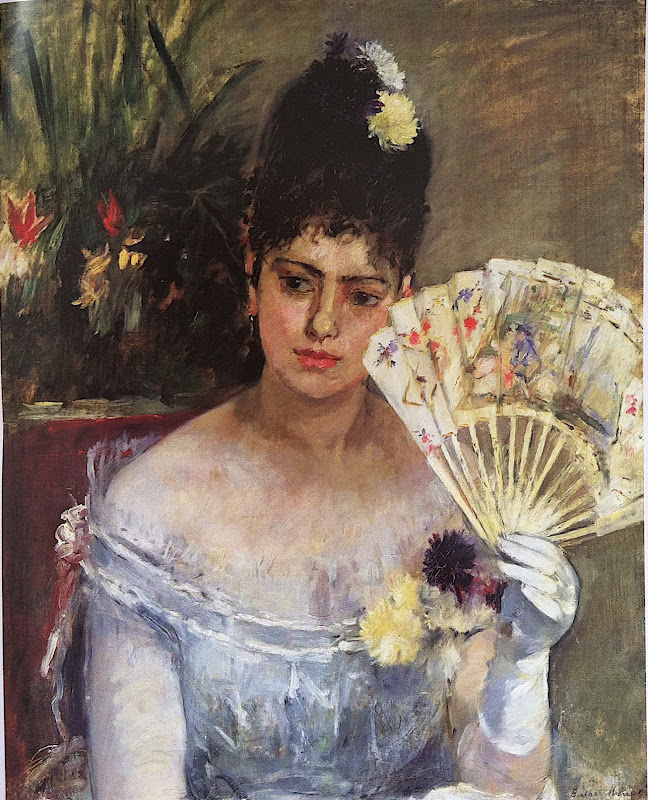
For the past two weeks, the whole of France has been pummelled day after day with soaking rain and high winds. "April in Paris" on steroids. Instead of strolling in the Luxembourg Gardens with friend Anneke visiting from Pt. Reyes Station, we headed instead to the Marmottan Museum, where the first retrospective of works by Berthe Morisot in 50 years is drawing appeciative audiences.
One of the few 19th century women to achieve recognition as a painter, Berthe Morisot was Edouard Manet's favorite model, appearing in many of his works. After marrying his brother, she settled down to producing an impressive body of work, exhibiting alongside Monet, Degas, Renoir, Pissarro and other Impressionist artists.
Sometimes dismissed as a "painter of women" I found her canvases not only captured the grace and femininity of women going about their daily lives, but also stood up strongly with her male counterparts. I especially liked this painting of a young woman watering the plants on her terrace, with the bulky urban city in the background.
On another recent rainy day, Matthew and I headed back to Idem, the last remaining lithographic printing studio in Paris. We were here about a year ago, but still the sight of this vast, skylit studio just stops you in your tracks.
We were here this time to visit our friend, the artist Edward Koren, who is "in residence" at Idem for a few weeks, creating lithographs for the first time in his life, and loving every minute.
He took some time to show us the various tools available, a big selection of lithographic pencils...
...or, if you prefer, you can use lithographic ink...
...which is what Ed is doing on this stone, being very careful to protect the stone from being contaminated by contact with his hand.
Meanwhile, over at one of the legendary 19th century lithographic presses, Pierre is readying the paper to continue working on Ed's first print, a group of wonderful Koren creatures with antlers and sparkly eyes, riding bicycles!
The stone itself sits in the well of the press, waiting for the big rollers and the smaller inked rollers to do their scientific as well as artistic magic.
And so they do! The first print comes off and is tacked up on the wall for close scrutiny by the artist and the master printers...
This first one has been printed with blue/black ink. Perhaps now a touch of yellow is needed in the background, but which shade...and how much...?
Christian, the color specialist, works with Ed and together they make their selection. A careful layering is painted onto the small rollers...
...and the new version comes rolling off the press and is tacked up on the wall. Just the subtle addition of the yellow softens the background, but sharpens the whiteness of the eyes and the bicycle wheels. Magnificent!
Speaking of bicycles, a couple of weeks ago, when the sun was shining, we took a Velib bike ride through the 5th arrondissement and were pulled up short by this imposing building set back from the road and covering a few acres. A sign told us it is the Val-de-Grace, a military hospital, medical school, museum and church, the last two of which one could visit. We quickly made a note to return soon.
Yesterday, under grey, threatening skies, we took the bus over just before the heavens opened and found ourselves inside a remarkable world of art, medical science and God!
Originally a Benedictine Convent, the courtyard of the old abbey building still retains the cloistered walkway running around the formal garden. Today, it houses an extraordinary museum of French army medicine.
In one room, we gazed in wonder at medical equipment from bygone years collected by a Monsieur François Debat, who pursued a life-long passion for the history of medicine, from this early microscope, a work of art in itself...
... to some fierce-looking surgical saws...
...beautiful glass flasks...
...portable pharmacies, complete with drawers and jars, powders and potions...
...and wild looking syringes!
There was even a life-size apothecary's shop, complete with exquisite ceramic jars and giant mortars and pestles.
Upstairs, we wandered through rooms that laid out beautifully the history of medicine in the French army. This painting shows an early field hospital during the Battle of Maastricht in 1747.
Other displays show students learning the art of foot anatomy and had some pretty explicit examples of fractured legs as well!
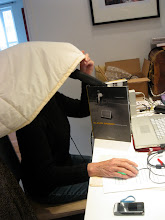
Some science fiction contraptions made you shiver to even think what injury this "helmet" might be attempting to heal...
...whilst others remained just plain mysterious. This one has something to do with stomach surgery, but as the box was closed tight, there was no way to know what the "complementaire" equipment might be!
Eventually, we made our way to the Church of the Val-de-Grace, which anchors the whole complex of buildings, sitting serenely in the centre. Built by order of Queen Anne of Austria (wife of Louis XIII), it was her way of thanking God for the birth of her son (who became Louis XIV) after 23 years of childless marriage, and at the age of 37! A miracle in 1638. The old Benedictine abbey was taken over and architects François Mansart and Jacques Lemercier went to work. The result is considered by some to be the finest example of baroque architecture in Paris. Louis XIV himself, at age 7, apparently laid the cornerstone.

Certainly when you walk inside the church, the scale alone makes you stop and gape, with its soaring ceiling and long, long apse. Then you slowly start to take in the details. The baldaquin, the canopy over the altar, is framed by twirled columns of marble, decorated with foliage from ivy and ferns to sheaths of wheat. The whole thing is incredibly ornate, even though it is supposed to represent the humble stable where Jesus was born!
A small sign told us that the original altar and baldaquin were destroyed during the French Revolution. An exact replica was built in the 19th century to restore the church to its former glory.
Looking up, the domed ceiling features an elaborate frescoe with Anne, and her patron, Saint Anne, and hosts of angels and adoring members of the populace. And below, the tiled floor is covered with fleur de lys, and the initials A and L for Anne and Louis.
The church also boasts a fine looking organ and offers free recitals every month.
At the far end of this extensive baroque complex sits the new hospital, built in the 1970s. It provides care to military personnel and also to anyone with health coverage under the French social security system. It is apparently the hospital of choice for leaders in the French government. No need to worry there about those scary surgical saws! Now, if we could just persuade Saint Anne to do something about this rain.....
À bientôt!
 That would be the Archangel Michael, slayer of dragons, who, according to legend, appeared to St. Aubert, a French bishop, in the 8th century and ordered him to build a church on a rocky islet off the coast of Normandy. Aubert dillied and dallied and ignored the angel's instruction until, again according to legend, Archangel Michael burned a hole in the bishop's skull with his finger!