Wednesday, January 5, 2022

A Tale of Two Brothers


They were born within a year of each other: Mikhail Morozov, on the left, in 1870, his brother Ivan the following year. Their great grandfather, Savva Morozov, was born into servitude. Somehow, he managed to create a silk ribbon workshop which quickly became so successful that in 1820 he was able to raise the colossal sum of 17,000 rubles to buy back his freedom and that of his family. They never looked back, building a hugely successful string of textile factories that, by the time Mikhail and Ivan were born, had amassed them enormous wealth and prestige. 


Their mother, Varvara Morozov, widowed in her mid-thirties, (seen here in a portrait by Konstantin Makovsky, 1884), took over the reins of the family business. At the same time, she made sure her sons (a third son Arsene was born in 1874), received a broad education, with a particular emphasis in literature, theatre and the arts. As teenagers, the brothers met most of the influential Russian painters of the day. They underwent apprenticeships with some of them, before turning their attention and their fortunes to creating their own art collections. Russian painters Konstantin Korovin and Valentin Sérov became valued advisers in this enterprise.


Valentin Sérov painted this portrait of Mikhail Morozov in 1902, capturing perfectly the height and portly breadth of the larger-than-life man. A great lover of music and dance and theatre, he was a jovial man of extravagant tastes and ambitions. He wrote theatre reviews, and by age 20 had begun collecting art. In the following thirteen years, he acquired some 83 works, almost equally divided between Russian and French artists. The trend would no doubt have continued, but for his untimely death at the young age of 33.


At the time of his brother's death, the quieter, more sober Ivan Morozov (painted here by Konstantin Korovin in 1903), was spending most of his time in the family factories. The profits made by his businesses, from orders submitted by the army in the Russo-Japanese War, enabled him to devote more time to growing his own art collection.


The result of the brothers' endeavors is currently on display at the Fondation Louis Vuitton, the Frank Gehry designed museum in the Bois du Boulogne: A total of 200 masterpieces from French and Russian artists:
The Morozov Collection. Icons of Modern Art, illustrating the emerging artistic modernity of the late 19th early 20th Century. This is the first time the collection has traveled outside of Russia since its creation. With some trepidation at mingling in what we knew would be a crowded event, we masked up, showed our "Pass Sanitaires" (both required for entry), and strode in!  To try and capture the size and scope of the exhibition is not possible, suffice it to say there are eleven galleries in all, each one packed with  paintings and sculptures that took our breath away.


Mikhail inherited his mother's love for France and all things French. By 1895 he had made regular visits to Paris, becoming acquainted with some of the leading art dealers, Ambroise Vollard, Eugène Druet and Paul Durand-Ruel. Soon paintings from some of the top artists of the time returned with him to Moscow. This full-length painting of the popular young actress Jeanne Samary by Renoir, painted in 1878,  took pride of place in his mansion. 


 A year after his brother's death, Ivan purchased a smaller Renoir featuring the same subject, Jeanne Samary, titled La Réverie perhaps as a tribute to his brother.


In 1901, Mikhail brought the first painting by Van Gogh ever to reach Moscow, Seascape at Saintes-Maries (1884), along with the first Gaugin work to enter Russia.


A small, dimly-lit room in the exhibition is devoted to this one painting! The Prison Courtyard (1890) is a departure from Van Gogh’s usual works. He painted it during his long months of confinement in the asylum of Saint-Rémy-de-Provence, inspired by a drawing by Gustave Doré. With his dangling arms, in the middle of the circle and looking at the viewer, Van Gogh has represented himself in the costume of a death row inmate. Ivan Morozov bought this painting in 1909 to complete his collection of Van Gogh paintings. It has never before been publicly exhibited.

Mikhail had a great passion for the French Impressionist painters, their landscapes, scenes of Parisian life, also their nudes, even though that was frowned on in Russia at the time. As well as this gorgeous Claude Monet Poppy Field, painted at Giverny in 1890-1891, he collected works by Manet, Corot, Toulouse-Lautrec, Degas, Bonnard, Denis, along with Van Gogh and Gauguin.

Ivan, too, was a lover of Gauguin's art. In 1908, he acquired this stunning painting, Woman Holding a Fruit (1893). In all, his collection has eleven Gauguin works.

Equally prominent in the collection are paintings by Henri Matisse. Commissioned by Ivan in 1909, this brightly colored still life, Fruits and Bronze, finds itself appearing as background in this painting...

...Portrait of Ivan Abromovich Morozov (1910) by the Russian painter, Valentin Sérov. A painting within a painting!

And then there are these three Matisse paintings which together are known as Moroccan Tryptich (1912-1913). Ivan had visited Matisse's studio, where he greatly admired the decorative qualities of the artist's paintings. He commissioned two landscapes in 1911. Matisse travelled to Morocco in 1912 and made these three paintings, completing them in 1913.

Earlier, in 1907, Ivan Morozov wanted to adorn his Moscow mansion with monumental decorative paintings. After visiting Maurice Denis' studio and seeing how he wove mythological references into his paintings, he commissioned him to produce a series of panels that would decorate his Music Room.
Known today as The Story of Psyche, in all, thirteen panels adorned the walls of the room, accompanied by decorative ceramic vases and life-size bronze figures sculpted by Aristide Maillot.

As I sat surrounded by these glorious panels, I imagined the room in 1909, filled with guests all decked out in their finery for a musical soirée. A grand piano in the centre, a suitably handsome/beautiful pianist sitting on the bench, raising their hands and beginning to play... maybe some Chopin Nocturnes, or perhaps Tchaikovsky, Mussorgsky, Rimsky-Korsakov!

The successful completion of his Music Room led Ivan next to commission Pierre Bonnard in 1910 to create a set of five large panels for the walls of his entryway and stairwell in his mansion. Bonnard used the theme of the seasons to fill these spaces. Here above, Autumn is represented by Fruit Picking...
 
...whilst summer is represented by this tryptich titled The Mediterranean. You can almost feel that hot, southern sun!

Whilst all these monumental decorative panels were being commissioned and executed, Ivan Morozov continued his trips to Paris, where he consulted with the art dealer professionals and added more and more canvases to his collection.  He bought this stunning "Blue Period" Picasso painting, Young Acrobat on a Ball (1905), from Leo and Gertrude Stein in 1913. It was the last modern painting to enter his collection...
 
The same year, 1913, he had added Picasso's astonishing Portrait of Ambroise Vollard (1910) to his treasure chest of art.

Along with his purchases made during his visits to Paris, Ivan Morozov had close ties with Russian artists of his generation who advised him on purchases to make, including this one, The Smoker (1911) by  Natalia Gontcharova...
 
...and this striking 1911 self portrait by Ilya Machkov.  Between 1904 and 1914, Ivan bought 240 works by French artists, while his Russian art collection grew to 430 pieces.


By far the largest number of paintings in the exhibition by a single artist were by Paul Cézanne. 17 -- that's seventeen -- canvasses were on display! Self-Portrait in a Cap (1873) was acquired by Ivan in 1907...


...Still Life with a Curtain (1892-1894) joined the collection in 1907...

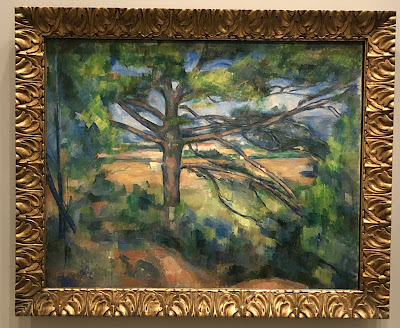
...and Great Pine near Aix (1895-1897) in September, 1908. Placed off-centre, the tree trunk stands firmly rooted, whilst its branches reach out across the width of the canvas, and beyond.  Here are two more Cézanne paintings from the exhibition: Trees in a Park (Jas du Bouffon) (1886), and Mont St. Victoire (1896-1898)


By the end of the first decade of the 20th century, the Morozov collections began to shift. In 1910, Mikhail's widow donated  about sixty of his most important Russian and European paintings to the Tretyakov Gallery in Moscow. With the outbreak of WWI, Ivan Morozov's trips to Paris came to an end.
 

Worse was to come. With the Russian Revolution in 1917, everything changed for Ivan . His business was taken over by the state, his home turned into a museum, and the collection of artworks he had worked so hard to build was nationalized. He was reduced to being an assistant curator of his own paintings. In 1919 he fled Russia, seeking asylum in Finland, before moving again to Czechoslovakia, where he died in 1921 of a heart attack at the age of 49.  His tomb at Karlovy Vary was only discovered in 2012. Surely, the heart attack was a result of a broken heart at having lost everything he had loved and cherished.


Shortly after his death, the collection was transferred to the Tretyakov Gallery, where it faded into relative obscurity, but the story did not end here.


The paintings were hidden in the Ural Mountains in the 1940s when the Nazis invaded Russia. Finally, the brothers’ collections were distributed around various Russian museums including the Hermitage, Tretyakov and Pushkin, where they live today. Though separated, the collection of over 700 works has been kept in excellent condition.  The name "Morozov" only appeared again on exhibition labels in Moscow and St. Petersberg in the 1990s.


The current exhibition at the Fondation Louis Vuitton took years of complex research and planning. We left the museum sending grateful thoughts to the curators who worked so hard to bring it all to fruition and, judging by the age range of the visitors we saw, opening the eyes of a whole new generation to these seminal works of art, and reminding us older patrons of the importance of this moment in modern art. 


BRAVO!


À bientôt! 


Tuesday, December 28, 2021

Plus ça change...

 ...plus c'est la même chose" ("The more things change, the more they are the same").  It's a well-worn phrase, but this time around I'm not so confident that it's true.

After a long, two-year absence, here we are back in our favorite city, in our favorite neighborhood, on our favorite rue Montorgeuil. There are always changes each time we return. Changes we notice and adjust to, without feeling anything's really that different.  But here, at the end of 2021, things are different.  The Covid pandemic has hit extra hard. The long months of lockdown played havoc with all the shops, restaurants, markets, and cafés in what is normally a bustling, prosperous neighborhood. Around the corner on the rue Reaumur, two of my favorite dress/accessories boutiques "Cachemire" and "Max Daniel", are shuttered, their spaces up for rent. I will miss their finely-made collections of sweaters, scarves, dresses, skirts, etc.   On the rue Montorgeuil itself, several stores and cafés have not made it, their storefronts boarded up.  Others are either replaced with a new shop, or under new ownerships. The results are mixed.


Biggest and worst change, for us, is that our beloved, most favorite café, La Grappe D'Or, has changed ownership. For eleven years, it's been our go-to spot for the perfect café crème, tartine or croissant for breakfast. Or their sandwiches, omelets, plats-du-jour for lunch, along with other delicious, freshly made dishes for supper. The most agreeable staff, who became friends over the years, welcomed us warmly on each of our returns. It was the first place we went to on our arrival. This year was no different. Except the bright red awning, seen above from 2019, is now green, the interior has been "gussied up" with retro white tiling on the walls, the menu is drastically reduced, whilst the prices have risen almost as dramatically.
 

This Croque-Monsieur looked pretty good, but turned out to be quite soggy with no flavor, the salad way over-dressed. And it cost 15 euros, half again as much as it would have cost before.


Also, to our great sorrow, not one of the original staff remains. Some took retirement, others have moved away. Wherever they are, we hope they have found new and rewarding situations. The new owners apparently "cleaned shop". The new staff are perfectly pleasant, but it's not the same, and we're kind of in mourning for what was! 


Clearly, we have to find a suitable replacement! High on the list is Les Petit Carreaux, at the very top of the street, just a few steps down from the rue Reaumur. 


Not only do they offer "vin chaud" during the cold weather...


...but they served me a delicious café crème and a tartine for a late breakfast the other day.  And if you sit outside under the heaters, they also offer cosy, red blankets for each customer to keep legs and feet warm!


This is a good moment to explain that it is not straightforward to enter a cafe, sit down, and place an order. The first important piece of business at the entrance is to show your "pass sanitaire", a digital record of your vaccinations. We obtained ours easily at a local pharmacy on presentation of our US vaccinations cards and an ID. Once scanned, it lives on your smart phone. As soon as the cafe staff person, or restaurant waiter, or theatre usher has verified your vaccination status, then you are welcomed, and life proceeds as normal. Masks are required in all indoor public spaces (except when eating, of course!). 


Outside, perhaps 60% of people wear masks all the time. Others have them lowered to their necks, ready to raise if needed.  They are "obligatoire" on all public transportation.


So, almost two weeks in, we are learning how to navigate this new world. And to welcome some new shops that have sprung up since our last visit, and that will definitely become favorites.


 A Belgian chocolate boutique, right across from the Marché U...


...its warmly-lit shelves enticing you inside!


 And almost at the bottom of the street, a welcome sight indeed: Ladurée, home of the world's greatest...


...MACAROONS, has put down roots in the neighborhood with a fairly modest store front, and a line out the door.


Happily, some of the more historic businesses have survived. One, Au Rocher de Cancale, has anchored the corner of rue Montorgeuil and rue Greneta for over 200 years.


In the 19th century, it was filled with dandies, writers, theatre and opera-goers, all feasting on oysters, the speciality of the house. A favorite haunt of Balzac, the café is featured in several of his novels.  Lovingly restored about four years ago, the interior is much simpler than in its heyday, but it is still a popular spot to enjoy a coffee and watch the world go by. We're glad to see it continues to thrive.


And we were happy to see that at precisely 1:30 pm on Sunday, the Poissonnerie Soguisa, along with their neighbors, the Palais du Fruit and La Boucherie de Montorgeuil, promptly closed their doors, in accordance with the city ordinance for Sunday business hours. After about 30 minutes of sweeping out the floors and gathering up the empty crates and boxes...


...right on cue, the garbage patrol slowly rolled by, emptying the filled garbage bins, an illuminated sign on top urging "patience" to any cars trying to navigate the street...


...with the sweeper truck bringing up the rear, scooping any residue bits and bobs, and restoring the street to its shiny cleanliness. So, maybe some things don't change!


Certainly the windows of the patisserie Collet have continued their tradition of mouth-watering displays of Bûches de Noël...


...and Matthew enjoyed his Christmas Day feast of Coquilles St. Jacques at the local brasserie, Au Gallopin, long a favorite with us!


Before that, though, we made our way down to the bottom of rue Montorgeuil to attend a free Christmas Day organ recital in the venerable Église St. Eustache, that has held careful watch over the neighborhood since the 17th century.


The soaring columns reach up breathtakingly high!


 Dutifully masked, we found seats fairly distant from others and waited for Monsieur Baptiste-Florian Marle Ouvrard to make his way to the organ.


With nearly 8,000 pipes, it is considered one of the most prestigious organs in France alongside that of La Cathédrale Notre-Dame de Paris. M. Marle-Ouvrard did not disappoint, presenting works from J.S. Bach, Tchaikovsky, and concluding with a piece by contemporary composer, Pierre Pincemaille, that almost literally "raised the rafters"!


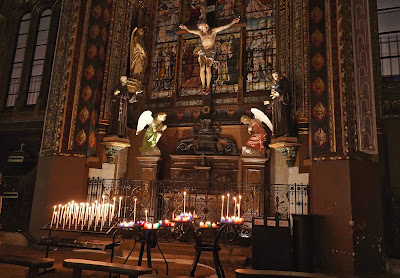
With our ears ringing from the glorious sounds, we made our way up a side aisle to the exit, stopping at this small chapel to notice the many candles lit in memory of loved ones lost during this time. A sobering reminder of the toll Covid has taken around the world.

So, with regrets at some of the changes, but gratitude for the things that have remained the same, we'll continue to enjoy this little corner of the world as safely and completely as we can.


 Happy, Healthy New Year!

À bientôt!